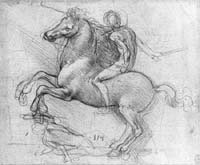
The story of Leonardo da Vinci’s horse starts in 1482 when the Duke of Milan, Ludovico Sforza, commissioned da Vinci to create the largest equine statue dedicated to his father (Italian Tribute). Now a patron of Sforza, Leonardo started preparations for this statue along with creating other pieces for the Duke. He first drafted a statue with a rider on a rearing horse; the weight from its front half would be supported by another soldier (presumably being trampled) that would connect the horse’s front hooves with the ground.

http://www.theequinest.com/the-horses-of-leonardo-da-vinci/
https://ph.qmul.ac.uk/sites/default/files/alumni/chronology_leonardo_th.jpg
This complicated design, though, was later discarded, and a new design with just one leg upraised was created (Google Arts and Culture). This design in itself was also difficult, as there would be no figure propping up the raised leg.


http://www.theequinest.com/the-horses-of-leonardo-da-vinci/
Leonardo planned to make this equine statue a stunning 16 feet tall, which would have needed around 70 tons of bronze (Italian Tribute). Even this choice of material is notable. In Panofsky’s Renaissance and Renascences in Western Art, he explains how sculptures in this era were usually “expected to consist of the same material as its surroundings and never gives the impression of being detachable; to adorn a facade with bronze figures placed in niches was… repugnant to the Gothic taste” (Panofsky 132). After studying the anatomy and physical structure of real horses, da Vinci created a 24-foot clay model that would be placed near the Duke’s castle (Science Center). But war disrupted da Vinci’s plans- in 1499 during the Second Italian War, Milan was invaded by French troops (History of War). Louis XIII, the French king, sent 17,000 infantry and 9,000 cavalry to take the city; desperate for arms, Sforza used the bronze da Vinci needed for his statue to create weapons for the Battle of Fornovo (Atlas Obscura). Even the massive clay model was destroyed by French archers who used it for target practice. With the materials he needed gone and his model ruined, Leonardo da Vinci abandoned his ambitious project and would never revisit it.
While the original project was never finished, Leonardo da Vinci’s design and innovative techniques demonstrate his heightened focus on anatomical realism and efficiency. In order to plan out his statue, Leonardo studied and sketched horses in Sforza’s stables (National Geographic). His early sketches showed that da Vinci was not only trying to get the statue to visibly look like a horse, but wanted to focus on having realistic proportions and anatomy. The following sketch shows da Vinci not focused on the pose he wanted the horse to be in, but rather understanding the anatomy of a horse.

http://www.theequinest.com/the-horses-of-leonardo-da-vinci/
This quality of portraying creatures as accurate models of themselves rather than just something that resembles their shape is seen in many of Leonardo’s earlier works, most famously in his Vitruvian Man. Leonardo had a great interest in thorough research, as seen in a passage in his notebook stating, “Science is an investigation by the mind which begins with the ultimate origin of a subject beyond which nothing in nature can be found to form part of the subject” (da Vinci 9). These realistic pieces represent a heightened awareness to realism, a principle of the Renaissance. Leonardo’s planned techniques to create the horse also showed Renaissance principles. In Kuhn’s essay The Structure of Scientific Revolutions, he mentions how “during revolutions scientists see new and different things when looking with familiar instruments in places they have looked before” (Kuhn 111). Da Vinci exemplified this sentiment; while using casting and molding, which had already been established, he imagined a new technique that would only require a single operation. Plaster molds would be created to shape the horse, and then the inverted molds would be buried between two ovens. Melted bronze would fill these molds to form the statue once cooled (National Geographic). Leonardo first thought that it would be best to place the mold into the ground upside-down with the hooves facing upwards, since it would be easier to fill the entire mold using the system of pipes for filling and chimneys for gas release.

https://www.europeana.eu/portal/en/exhibitions/the-colossus-of-leonardo-da-vinci/two-different-casting-methods#ve-anchor-section_5929-js
After more planning, though, Leonardo decided that this approach would not work; since Milan had a water table depth of about five meters, his proposed 16 foot tall statue would not fit under the ground without breaching the water table. Leonardo decided that the only method to cast the horse would be to cast it horizontally, putting the cast into the ground with one flank facing the surface (Europeana).

https://www.europeana.eu/portal/en/exhibitions/the-colossus-of-leonardo-da-vinci/two-different-casting-methods#ve-anchor-section_5929-js

https://i.pinimg.com/originals/f9/4c/4a/f94c4a9000f282708517f910ee9ea29c.jpg

https://www.flow3d.com/wp-content/uploads/2014/04/leonardo-da-vinci-bronze-horse-casting.png
By combining all work into the process of filling the molds, Leonardo designed a very effective and time-efficient way to create such a large statue; after the casts had been created, they could also be used multiple times provided they were filled with more bronze. Like many of his other invention ideas such as his war designs, Leonardo was rethinking the ‘intimacy’ of past eras and looked to experiment with techniques that would make a standard, potentially mass-produced object.
But the story of Leonardo’s horse statue doesn’t end with war and abandonment; the project was picked up again, centuries later, to form the modern statues that are based on da Vinci’s original designs. In 1977, retired pilot and Renaissance art enthusiast Charles Dent read a National Geographic article about da Vinci’s abandoned horse project and the notebooks that still existed (Atlas Obscura). Inspired, Dent resolved himself to continue da Vinci’s vision. He first created an organization called Leonardo da Vinci’s Horse, Inc. in 1982 to start building the statue. After Dent passed away in 1997, sculptor Nina Akamu stepped in to finish the statue.

This new statue was not meant to be an exact replica of what da Vinci planned for; instead, as Nina Akamu stated, it was “significantly influenced by certain works of art and writings from that period, and specifically Leonardo’s notebooks and accompanying drawings with great emphasis on his involvement with the Sforza monument” (Atlas Obscura). The final creation, measuring an impressive 25 feet tall and weighing 15 tons, was placed in San Siro Hippodrome Culture Park in Milan, Italy on September 10, 1999 (Da Vinci Science Center).
Through examining da Vinci’s early designs, study of anatomy, and innovative casting techniques, his display of Renaissance principles can be seen throughout the entire process of planning the largest equine statue. And while Leonardo never got the opportunity to finish his project, Charles Dent, Nina Akamu, and many other passionate people created a statue based on Leonardo’s original designs. This redesign represents more than just a continuation of a failed project; it stands in Milan as a celebration of da Vinci’s legacy, a display of the bond between the nations, and most importantly a representation of the ways da Vinci continues to inspire creators in the modern world.

https://media2.trover.com/T/55eeaba77eb4f44745070d5e/fixedw_large_4x.jpg
COVE Timeline Elements:
https://editions.covecollective.org/chronologies/leonardo-da-vinci-plans-largest-equestrian-statue
https://editions.covecollective.org/chronologies/leonardo-da-vinci%E2%80%99s-horse-inc-forms
COVE Map Elements:
https://editions.covecollective.org/place/santa-maria-delle-grazie-milan-italy
https://editions.covecollective.org/place/fogelsville-pennsylvania
COVE Gallery Elements:
https://editions.covecollective.org/content/study-horse
https://editions.covecollective.org/content/creation-leonardos-horse-statue
Bibliography
Admin, et al. “Leonardo: Milan 1482 – 1499 (Part II).” The Italian Tribune, 16 July 2019, www.italiantribune.com/leonardo-milan-1482-1499-part-ii/.
“Why Leonardo’s Last Statue Took 500 Years to Finish.” National Geographic, 30 Apr. 2019, http://www.nationalgeographic.com/history/magazine/2019/05-06/after-death-da-vinci-sculpture-completed/.
“The Full Story of Leonardo’s Horse.” Da Vinci Science Center, www.davincisciencecenter.org/about/mission-and-history/leonardo-and-the-horse/the-full-story-of-leonardos-horse/.
Da Vinci, Leonardo, and Irma A. Richter. Leonardo Da Vinci: Notebooks. Edited by Thereza Wells, Oxford University Press, 2008.
Kuhn, Thomas S. The Structure of Scientific Revolutions. 4th ed., The University of Chicago Press, 2015.
Panofsky, Erwin. Renaissance and Renascences in Western Art: Text. Almqvist & Wiksell, 1965.
“Second Italian War/ Italian War of Louis XII (1499-1503).” History of War, http://www.historyofwar.org/articles/wars_second_italian_war.html.
“Study for an Equestrian Monument (Recto) – Leonardo Da Vinci – Google Arts & Culture.” Google Arts & Culture, Google, artsandculture.google.com/asset/study-for-an-equestrian-monument-recto-leonardo-da-vinci/CQHpQyy0bvQVNA?hl=en.
Ugc. “Leonardo’s Horse – Il Cavallo Dello Sforza.” Atlas Obscura, Atlas Obscura, 16 Apr. 2010, www.atlasobscura.com/places/leonardo-s-horse-il-cavallo-dello-sforza.\
 Italy Imagined