Assignment 6
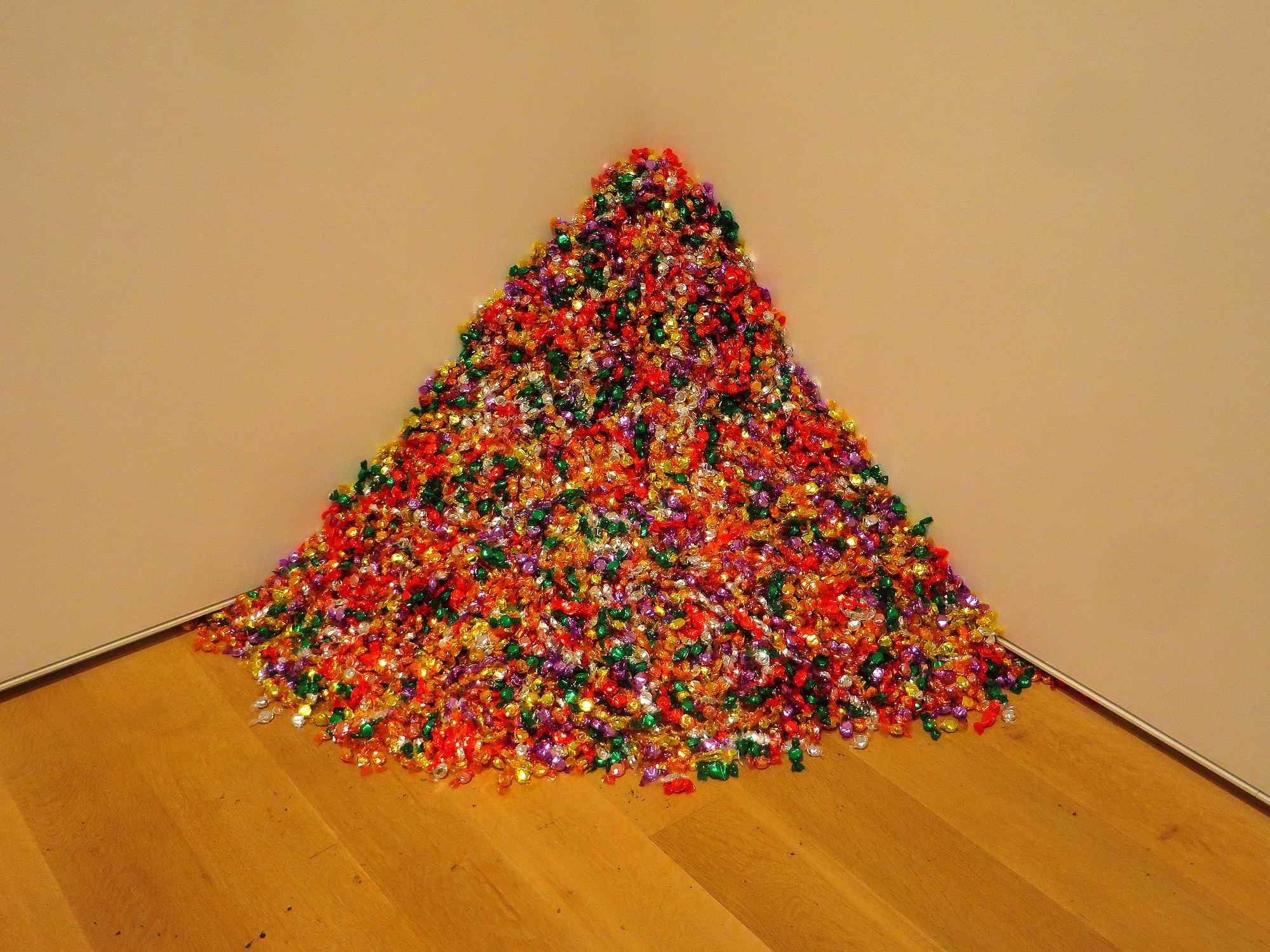
Felix Gonzalez-Torres’s “Untitled” (Portrait of Ross in L.A.), created in 1991 and currently installed at the Art Institute of Chicago in Chicago, Illinois, represents a stark contrast from the Renaissance paradigm. This work of art consists of a pile of candies that weigh 175 pounds. Viewers of the piece are allowed to take a piece of candy; in the morning, the missing pieces of candy are replenished so the pile is again at 175 pounds. Each candy is individually wrapped in different colors of bright, shiny wrapping and comes in many different sizes and shapes. The inspiration behind this piece is a harsh departure from the cheerful candy wrappers. Felix Gonzalez-Torres’s partner, Ross Laycock, was dying of AIDS during the AIDS crisis; 175 pounds was his healthy weight before he began to lose weight from the disease. As viewers take candy away piece by piece, Ross’s slow decline of health takes a physical form. The candy’s bright, unassuming appearance reflects the inaction and misinformation that was prevalent during the AIDS crisis in America, and how many unaffected Americans during this time turned a blind eye and, in part, contributed to how devastating the disease was. But every morning, the candy pile gets replenished, perhaps giving Ross the longer life that the disease stole from him.
“Untitled” (Portrait of Ross in L.A.) seems to take the Renaissance’s principle of realism to its furthest extent, but instead takes it in a very different direction. Gonzalez-Torres uses real objects (the multi-colored pieces of candy) in his art installation and physically puts them on display- in the Renaissance, Renaissance artists showed a new focus on realism by trying to represent scenes and figures exactly as how they are in real life. At first glance, Gonzalez-Torres seems to be doing this by using real objects in his exhibit. Once learning about the inspiration and meaning behind his piece, there seems to be a twist of the Renaissance principle of ‘realism’; while Gonzalez-Torres is using real objects, he is not trying to make them appear as what they exactly are. Rather, they are meant to represent something else; not just in there appearance, but how a viewer interacts and perceives them. The story behind Gonzalez-Torres’s “Untitled” (Portrait of Ross in L.A.) gives his art piece more depth and a break from trying to portray objects as exactly how they appear.
“Untitled” (Portrait of Ross in L.A.) also challenges the viewer to question themselves. During the Renaissance, there was a theme of celebrating humans as they were; Renaissance art started to focus more on regular, day to day people instead of just religious figures, and represented them with more accurate proportions and figures. Leonardo da Vinci’s many works that featured the human figure, most famously his Vitruvian Man, ignores the reluctance to draw the nude figure that was prevalent in earlier times. Gonzalez-Torres’s art piece, however, invites viewers to look critically at themselves. Visitors are compelled to take a piece of candy, fooled by the bright and seemingly harmless packaging and failing to do proper research or consider what these candies represent. In doing this, they unwittingly fall into the role of a bystander. By showing visitors of his artwork how easy it is to fall into the position of complacency and inaction, Gonzalez-Torres makes this exhibit into a learning experience that might open people up to their own flaws.
Gonzalez-Torres’s “Untitled” (Portrait of Ross in L.A.) reflects the Renaissance’s principle of accuracy and mathematical measures of precision, but in a different, non-visible way. Renaissance architecture often showed very precise properties; remarkable symmetry, straight edges, clean shapes, and a distinct ‘grid-system’ features on some plane. Gonzalez-Torres’s piece of art, made up entirely by a single pile of candy, does not seem to show this principle at all. The candy is not placed in a certain order, only stacked on top of each other; as people randomly take from the pile, it starts to deteriorate unevenly, some candies on the top rolling down to the bottom as the base of the pile is weakened. The entire exhibit, at first glance, seems very unintentional; some might not even know that it is a piece of art at all. But the artwork’s focus on accuracy and measurements come with the maintenance of its specific weight at 175 pounds; every morning, more candies are added to get the pile at this target weight. Like many other qualities of postmodern art, this shows how thought is being put into more than just what is visible to the viewer; the artist, Gonzalez-Torres, wants the viewer to focus on the conditions and actions that the art piece itself is experiencing.

 Italy Imagined