In Paul Virilio’s Speed and Politics, he describes the open sea to “compensate for every social, religious and moral constraint, for every political and economic oppression, even for the physical laws due to the earth’s gravity, to continental crampedness” (Virilio 65). In many ways, this relates to how many viewed the Internet at the time of its introduction to people’s home machines. The Internet was supposed to represent a rebirth for information; it would allow people to access any type of knowledge that they wanted, connect individuals from across the country, and serve as a medium to share your ideas and stories. And it certainly has, allowing information to travel at an unprecedented rate and people to connect from all over the world.
This can be compared to the shifting paradigm of the Renaissance. With the advances in transportation and spread of information, the world became more connected during the Renaissance. Just as the Internet represented a rebirth of information, the Renaissance experienced a rebirth of thought that was reflected in art, architecture, innovations, and many other establishments.
But the ‘open sea’, as Virilio describes, does not only free people from oppression and physical barriers; the open sea “became the right to crime, to a violence that was also freed from every constraint” (Virilio 65). The freedom of the open sea did not just serve as a medium for free travel and thought, but an expansion of violence and war. The changes of the Renaissance reflects this as well; along with innovations in medicine, art forms, and transportation, there were innovations in war. Weapons became deadlier, easier to use, and more indiscriminate with who they targeted.
The expansion of the Internet and the freedom of knowledge is no exception to this behavior, and the way America is dealing with the COVID-19 pandemic reflects it. America has fairly liberal laws on Internet usage, and while this has allowed the spread of ideas and knowledge, it has been just as good at spreading disinformation. During this pandemic, many people have been helped by looking at trustworthy websites (such as the Center for Disease Control’s website) to learn more about how to stay safe and how to avoid endangering themselves and others. But many have turned to the Internet to look for what they want to hear; that the disease is fake, that it is a conspiracy, that the virus is ‘not as lethal’ as the CDC warns. This type of information, found in tabloids and conspiracy videos and certain online communities, is just as proliferous as information from reputable sources. This type of misinformation is not without consequence; with armed protests happening in many cities and groups of people refusing to quarantine, these people pose a serious threat to all Americans. In one of his notebooks, da Vinci wrote, “Let no man who is not a mathematician read the elements of my work” (da Vinci 9). As elitist and highbrow as it sounds, it has some truth given our current situation- many times people will read legitimate information, but will not have the proper background to realize its legitimacy or use it in a productive way.
This severe response and militant disbelief serves as a haunting reflection of what the open Internet serves for in democratic countries. Compared to other countries, America’s internet is relatively ‘free’, and government censorship is limited. In response, the media and the Internet has been flooded with misinformation and biased pieces that are passed off as ‘news’. Instead of using technology to get educated, most people use our many sources of information to confirm their long-standing biases. This is a stark contrast to authoritarian-ruled countries like China, where the Internet is heavily censored and technology is used as a government tool to control their population. This heavily controlled Internet is easily able to control massive groups of people by only allowing government-approved ‘truths’. And while this does not fit the idea of the ‘open sea’ as Virilio imagined it, this type of control has worked frighteningly well during the COVID-19 pandemic with many areas of China having quarantine restrictions lifted already.
While the outbreak is far from over, I hope America’s response will put our usage of the Internet in speculation again. This incident, and many incidents before now, have shown that misinformation is extremely dangerous, and that the spread of conspiracies and biased articles have deadly consequences. Only by addressing these problems can we prove that the Internet can be used as a free, open medium to spread thoughts and knowledge instead of being a favorable tool to control the public.
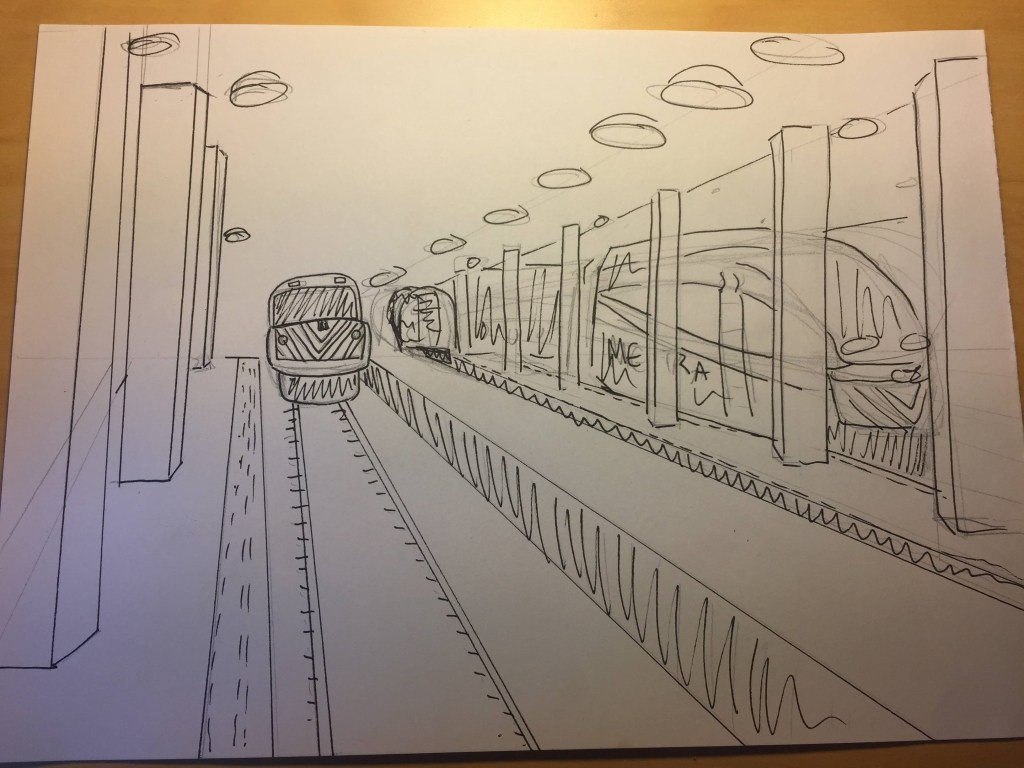
I heard the train starting to leave at the top of the steps of Union Station’s Madison entrance; people, clutching their briefcases and backpacks, pushed their way past me to fly down the stairs and shove their way onto the train. I did not change my leisurely pace down the stairs, keeping a firm hold of my own backpack as I got jostled around by commuters. With a deafening screech and puffs of exhaust that spewed a thick, sickening odor, the train rolled past me out of the station. A couple of stragglers, just jogging into the station, stagger to a stop as they forlornly watch the train retreating into the city.
With the only source of light some flickering overhead lights that coughed up a weak, sterile glow and the tiny amount of daylight that filtered in from the edges of the station, the train platform seemed gloomy and dull. Rows of train tracks cascaded from both sides of me; some tracks were occupied by a train, with people jogging to board, but most were empty. Cement pillars dotted the strip of cement that I was standing on, with a uniform distance between each of them. Some dripped with a strange liquid- too dark to be water, I thought as I squinted at the mysterious drops, but they didn’t seem to have a smell. Well, even if they did, the oppressive odor of gasoline and exhaust overpowered my senses.
The air felt more and more stuffy; I heard another shrill squeal to my right a train from an adjacent track pull in. I walk forward, past the cement pillars and the mystery liquid and the disappointed people who had resigned themselves to wait for the next inbound train, towards the sliding doors that led to the interior of Union Station. The automatic doors slid open easily as I approached them, a gust of air conditioning rushing out to meet me.
The moment I walked into the station, a warm, yellow light washed over me. The screeches and whines of the trains were instantly replaced by the normal bustle of the station; shoes tap-tapping across the tiled floors, indistinct conversation, and the constant ‘Track Nine… Track Nine…’ that constantly played near the entrance of each track for the hearing impaired. The automated voice melted into each other as if fighting for attention, creating a robotic racket of ‘Track Nine- Five – track – Eleven – Track Nine…’. The overlapping voices, for some reason, were soothing to me; it was certainly better than the noise on the train platform.
Union Station, to some, might seem ugly and outdated. But I consider Ruskin’s belief in de Botton’s The Art of Travel when he stated “Many places strike us as beautiful not on the basis of aesthetic criteria- because the colours match or symmetry and proportion are present- but on the basis of psychological criteria, inasmuch as they embody a value or mood of importance to us” (de Botton 229). The parts of Union Station by themselves- the gloomy train platform, the busy station, the outdated equipment- might not fit with an ideal aesthetic, but it’s the ‘psychological criteria’ that makes the station so appealing to me. The ebb and flow of people rushing in and out of the city, the constant chatter, and the familiar stores and restaurants make me feel comfortable; to me, it is not the aesthetic, but the atmosphere of Union Station that makes me so drawn to it.
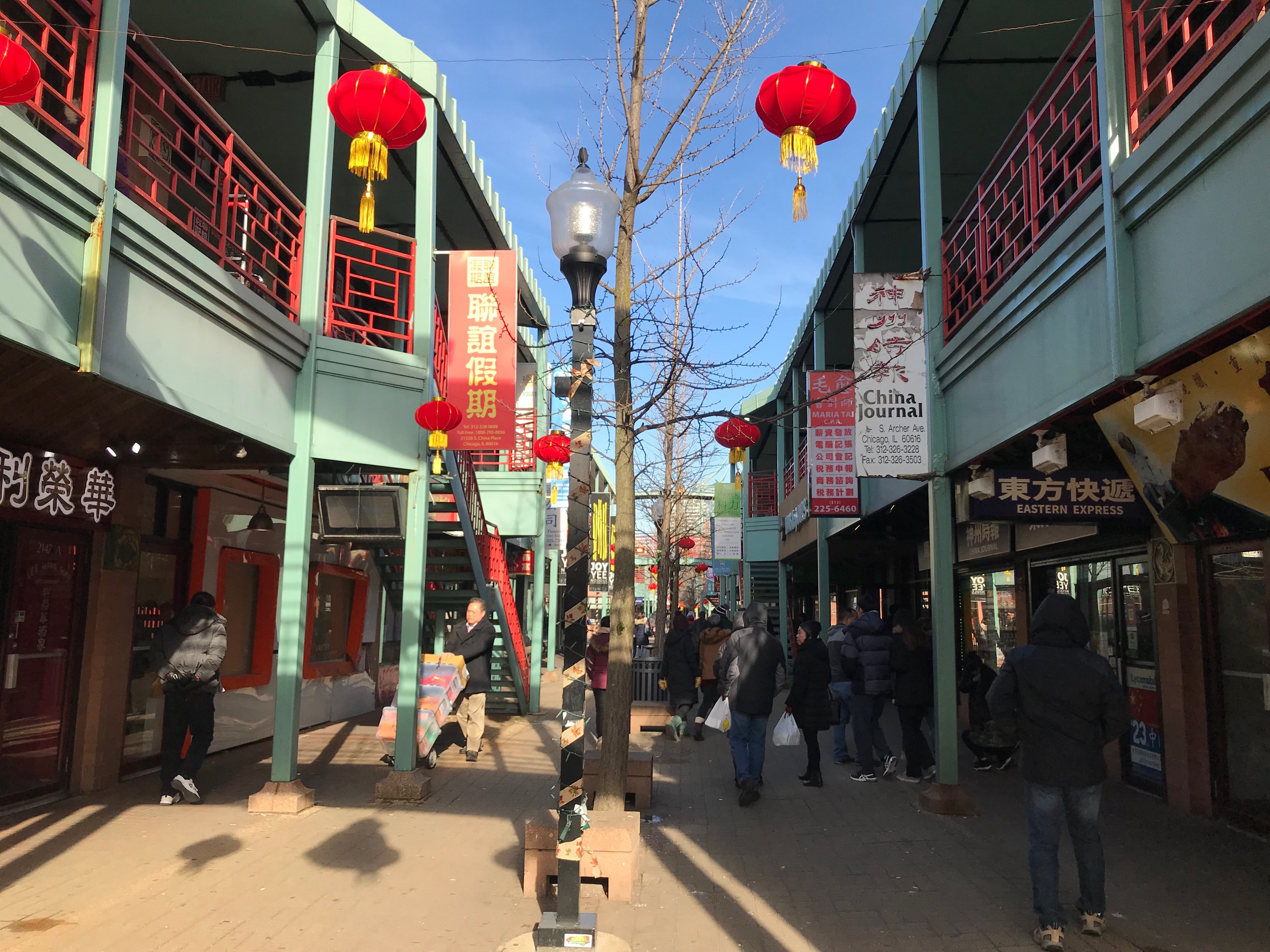
For many, visiting Chicago’s chinatown means visiting a flashy tea place or eating at a trendy dumpling restaurant. For the more adventurous, you could even go to a dim sum restaurant to choose from a variety of buns and other small-portioned dishes. But my family often chooses a restaurant on the lesser-visited top floor of Chinatown. Above the nice courtyard filled with zodiac statues and unadorned with the decorational gazebos and red-and-turquoise arches of the lower level, the pathway that winds around the top floors of the Chinatown business is flanked by darkened windows. Instead of glowing store signs and tacky gift shops, there are bookstores and office supply stores and a Kumon nestled into a small corner.
If you follow the path towards Wentworth Avenue, you can visit the small restaurant my family frequents. The name, written above the door in Chinese, escapes me- even a search on google maps pulls up no registered restaurant for this location. It’s on a corner, so two walls have expansive, plexiglass windows that look out onto the darkened alley behind chinatown and the street beyond it. There’s a quiet jingle of the bells hung on the door as you walk in.
There’s a waitress sitting near the door on her phone, and she glances up as you come in. She immediately speaks in Chinese to ask how many people we have, although she’d be able to switch to English if you said you didn’t understand. After grabbing the correct amount of menus, she silently leads us to our table, still on her phone. She puts down the menus and nods at us, leaving again to retrieve some waters.
The booth we’re in has dark, leather-covered plush seats; there’s some small tears in the fabric, and you can make out spongy fluffs from within the chair. Since we only have a table of four, there’s no lazy susan on the table, but the large round tables in the center of the restaurant all have the spinning disk in the middle. The walls are white and are lined with printed pieces of paper with Chinese scrawled on with Sharpie- they list special deals and popular menu items, and some have pictures of the food that look like they’ve been taken from a cellphone camera. If you were to compare the items on the wall to the items on the menu, you would find many more types of dishes on the walls.
The restaurant plays no music, but it has three small TV screens on three of its walls. Each TV is soundless and is playing different stations; one is a Chinese news channel, one is a game show, and one seems to constantly be playing ads. The only sounds is the constant drone of laughter and talking from neighboring tables- which, with the lack of decorations and open floor plan, is very easy to hear- and the usual racket from the kitchen. A glance at the menu shows rows upon rows of different dishes, but upon a closer look the selection of meals seems to focus on a limited number of ingredients. This reflects a prevalent quality in a lot of Asian cooking; reusing and reinventing the same set of key ingredients.
Our waitress is back to take our order. She spares no words, jotting down our orders before retrieving our menus, saying “Ok”, and heading back to the kitchen. To people used to American-style restaurants, going to a casual, authentic Chinese restaurant many times does not fit their preferred restaurant qualities- cheerful waiting staff, visually pleasing decorations, and calm atmosphere are not a priority in places like the Chinese restaurant my family visits. Some find this off putting, and it has led to a stereotype of Chinese waiters and waitresses seeming to be rude or inconsiderate. But for these casual Chinese restaurants, bubbly employees and the ‘atmosphere’ of the space is much less important than the food being served and the company of the people around your table. The absence of music, lack of interference of waiters and waitresses, and communal sitting areas (with large, round tables and the lazy susan), all encourage conversation and a sense of community with the people you’re sitting with. And it’s easy to reach out to a waiter and waitress for conversation; the customer just has to initiate it. When my family brings our grandparents to dine with us, the cooks will often come out and talk about their hometowns, sometimes pulling up a seat to chat longer. Casual Chinese restaurants aim to provide exactly what they advertise; a place for food and casual conversation.
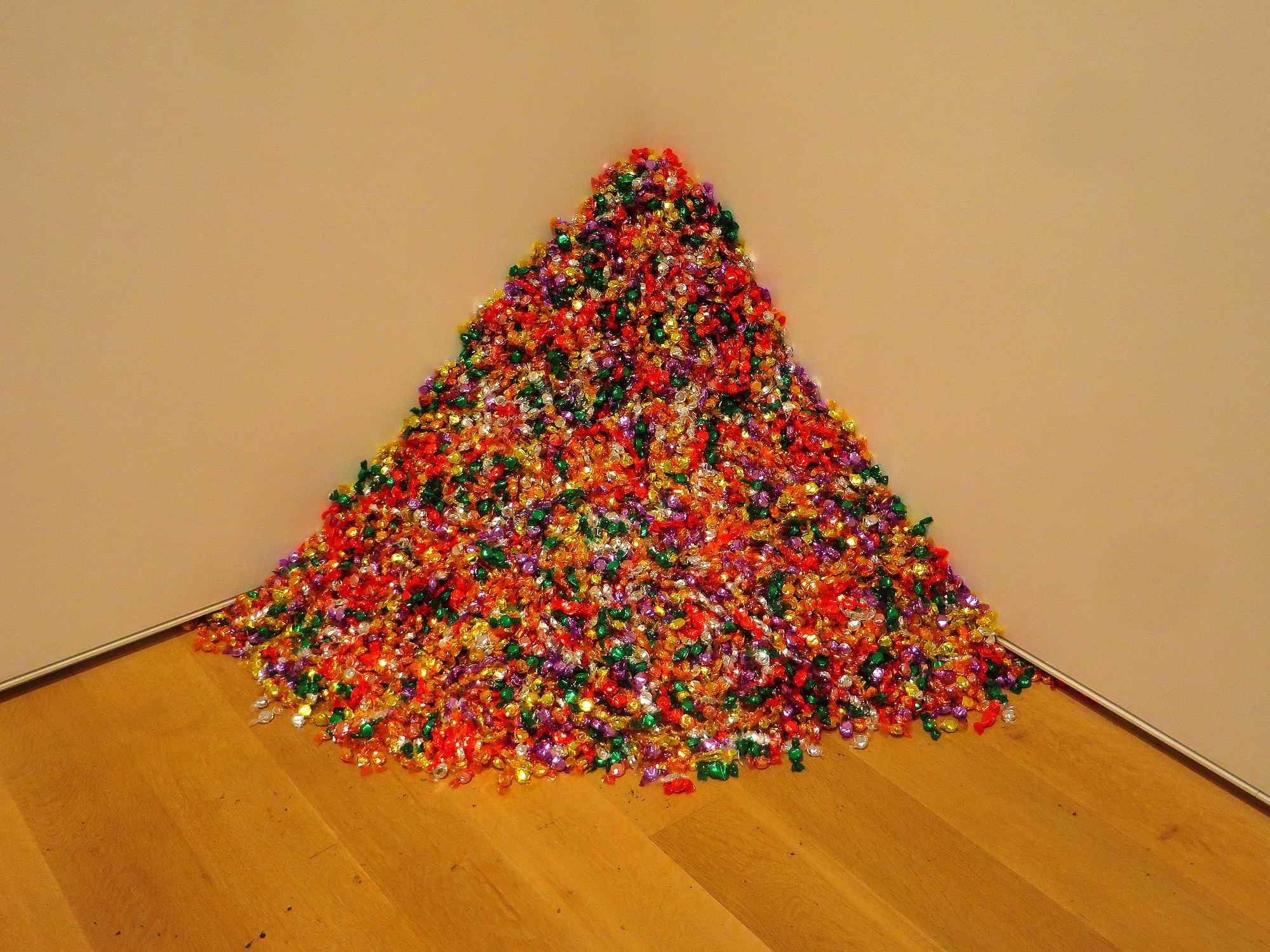
Felix Gonzalez-Torres’s “Untitled” (Portrait of Ross in L.A.), created in 1991 and currently installed at the Art Institute of Chicago in Chicago, Illinois, represents a stark contrast from the Renaissance paradigm. This work of art consists of a pile of candies that weigh 175 pounds. Viewers of the piece are allowed to take a piece of candy; in the morning, the missing pieces of candy are replenished so the pile is again at 175 pounds. Each candy is individually wrapped in different colors of bright, shiny wrapping and comes in many different sizes and shapes. The inspiration behind this piece is a harsh departure from the cheerful candy wrappers. Felix Gonzalez-Torres’s partner, Ross Laycock, was dying of AIDS during the AIDS crisis; 175 pounds was his healthy weight before he began to lose weight from the disease. As viewers take candy away piece by piece, Ross’s slow decline of health takes a physical form. The candy’s bright, unassuming appearance reflects the inaction and misinformation that was prevalent during the AIDS crisis in America, and how many unaffected Americans during this time turned a blind eye and, in part, contributed to how devastating the disease was. But every morning, the candy pile gets replenished, perhaps giving Ross the longer life that the disease stole from him.
“Untitled” (Portrait of Ross in L.A.) seems to take the Renaissance’s principle of realism to its furthest extent, but instead takes it in a very different direction. Gonzalez-Torres uses real objects (the multi-colored pieces of candy) in his art installation and physically puts them on display- in the Renaissance, Renaissance artists showed a new focus on realism by trying to represent scenes and figures exactly as how they are in real life. At first glance, Gonzalez-Torres seems to be doing this by using real objects in his exhibit. Once learning about the inspiration and meaning behind his piece, there seems to be a twist of the Renaissance principle of ‘realism’; while Gonzalez-Torres is using real objects, he is not trying to make them appear as what they exactly are. Rather, they are meant to represent something else; not just in there appearance, but how a viewer interacts and perceives them. The story behind Gonzalez-Torres’s “Untitled” (Portrait of Ross in L.A.) gives his art piece more depth and a break from trying to portray objects as exactly how they appear.
“Untitled” (Portrait of Ross in L.A.) also challenges the viewer to question themselves. During the Renaissance, there was a theme of celebrating humans as they were; Renaissance art started to focus more on regular, day to day people instead of just religious figures, and represented them with more accurate proportions and figures. Leonardo da Vinci’s many works that featured the human figure, most famously his Vitruvian Man, ignores the reluctance to draw the nude figure that was prevalent in earlier times. Gonzalez-Torres’s art piece, however, invites viewers to look critically at themselves. Visitors are compelled to take a piece of candy, fooled by the bright and seemingly harmless packaging and failing to do proper research or consider what these candies represent. In doing this, they unwittingly fall into the role of a bystander. By showing visitors of his artwork how easy it is to fall into the position of complacency and inaction, Gonzalez-Torres makes this exhibit into a learning experience that might open people up to their own flaws.
Gonzalez-Torres’s “Untitled” (Portrait of Ross in L.A.) reflects the Renaissance’s principle of accuracy and mathematical measures of precision, but in a different, non-visible way. Renaissance architecture often showed very precise properties; remarkable symmetry, straight edges, clean shapes, and a distinct ‘grid-system’ features on some plane. Gonzalez-Torres’s piece of art, made up entirely by a single pile of candy, does not seem to show this principle at all. The candy is not placed in a certain order, only stacked on top of each other; as people randomly take from the pile, it starts to deteriorate unevenly, some candies on the top rolling down to the bottom as the base of the pile is weakened. The entire exhibit, at first glance, seems very unintentional; some might not even know that it is a piece of art at all. But the artwork’s focus on accuracy and measurements come with the maintenance of its specific weight at 175 pounds; every morning, more candies are added to get the pile at this target weight. Like many other qualities of postmodern art, this shows how thought is being put into more than just what is visible to the viewer; the artist, Gonzalez-Torres, wants the viewer to focus on the conditions and actions that the art piece itself is experiencing.
Innovations in movement, communication, and knowledge has made our society ever increasingly interconnected and diverse. Cultures, previously separated by mountain ranges or oceans or forests, now have a chance to be spread worldwide. This flow of ideas and cultures have laid the groundwork for heterotopias, something that Foucault describes as an establishment that reflects many different places; he describes it like a mirror, and how it “makes this place that I occupy at the moment when I look at myself in the glass at once absolutely real, connected with all the space that surrounds it, and absolutely unreal, since in order to be perceived it has to pass through this virtual point which is over there” (Foucault 24). There are many types of heterotopias; some examples are heterotopias of time (such as a museum) that try to recreate spaces from a different time period or a heterotopia of deviation (such as a prison) where behavior inside is different from the outside world. Other heterotopias exist that are “capable of juxtaposing in single real place several spaces, several sites that are in themselves incompatible” (Foucault 25). Lincoln Park Zoo, a free zoo located at 2001 N Clark St, Chicago, demonstrates many characteristics of a heterotopia, and is a perfect example of the spaces the Foucault imagines.
Through its choice of exhibits and design, Lincoln Park Zoo shows its ability to juxtapose many different spaces. Just by walking through the zoo, a guest can experience a wide range of cultures, environments, and knowledge. This goes farther than the exotic animals- the zoo creates cultural ‘zones’ within its perimeter and uses the decoration, exhibit names, and vegetation to fit the animals they feature. For example, ‘Regenstein’s African Journey’ features Giraffes, Rhinos, and Pigmy Hippos and takes visitors on a wooden walkway lined with African plants that lead you from each animal exhibit. There are informational boards on nearly every wall that give information about the country that these animals originate from and their current conservation status. The space is kept at high humidity and the lights are dim, giving visitors the feeling of walking through a jungle.
Just across the zoo, though, the scenery completely changes at the farm-in-the-zoo which features cows, goats, chickens, pigs, rabbits, and other farm animals. In one section, people are invited into a fenced area to brush goats. The space is covered with open fields and wooden fences, and inside a bright red barnhouse there’s a large demonstration area that shows visitors how cows are milked. These two areas, both very different from each other, are both in the same zoo- they are a juxtaposition of two different environments, one a jungle and one a countryside, that offer visitors a glimpse into a different culture without having to book a plane flight.
The borders of these zoo ‘zones’ are not strict, though; the many cultures in the zoo overlap to form an integrated network. In his essay, Foucault mentions how “we do not live in a kind of void, inside of which we place individuals and things… we live inside a set of relations that delineates sites which are irreducible to one another and absolutely not superimposable on one another” (Foucault 23). Lincoln Park Zoo does not escape this ‘set of relations’. One aspect of this idea are the people inside the zoo. The visitors themselves also bring a bit of culture with them; while walking throughout the park, snippets of conversation from other guests are often in different languages. As one of Chicago’s most famous attractions, many tourists from other countries come to experience the zoo. This, along with Chicago’s diversity, leads to Lincoln Park Zoo hosting people from all around the world with different backgrounds and experiences.
Lincoln Park Zoo also has qualities of a heterotopia of deviation. Nestled between Lake Michigan and Lincoln Park, the zoo is an environmental change when you approach from any direction. Lincoln Park follows Chicago’s grid system, with rows and rows of apartments, offices, restaurants, and other buildings. Pockets of grass, mostly contained within public parks, are sparse. Upon entering Lincoln Park Zoo, the scenery flattens and expands. Buildings no longer block your view, and suddenly grass and trees surround you. Behavior inside, with zoo visitors relaxing outside of the greenhouse and looking at animals, is a stark difference to the business-as-usual mindset from the offices surrounding the park. With pretzel stands, many street performers playing kids songs on guitars, and other interactive displays, stepping into the park immediately transports visitors into an environment different than what they would expect of Chicago.
The story of Leonardo da Vinci’s horse starts in 1482 when the Duke of Milan, Ludovico Sforza, commissioned da Vinci to create the largest equine statue dedicated to his father (Italian Tribute). Now a patron of Sforza, Leonardo started preparations for this statue along with creating other pieces for the Duke. He first drafted a statue with a rider on a rearing horse; the weight from its front half would be supported by another soldier (presumably being trampled) that would connect the horse’s front hooves with the ground.
This complicated design, though, was later discarded, and a new design with just one leg upraised was created (Google Arts and Culture). This design in itself was also difficult, as there would be no figure propping up the raised leg.
Leonardo planned to make this equine statue a stunning 16 feet tall, which would have needed around 70 tons of bronze (Italian Tribute). Even this choice of material is notable. In Panofsky’s Renaissance and Renascences in Western Art, he explains how sculptures in this era were usually “expected to consist of the same material as its surroundings and never gives the impression of being detachable; to adorn a facade with bronze figures placed in niches was… repugnant to the Gothic taste” (Panofsky 132). After studying the anatomy and physical structure of real horses, da Vinci created a 24-foot clay model that would be placed near the Duke’s castle (Science Center). But war disrupted da Vinci’s plans- in 1499 during the Second Italian War, Milan was invaded by French troops (History of War). Louis XIII, the French king, sent 17,000 infantry and 9,000 cavalry to take the city; desperate for arms, Sforza used the bronze da Vinci needed for his statue to create weapons for the Battle of Fornovo (Atlas Obscura). Even the massive clay model was destroyed by French archers who used it for target practice. With the materials he needed gone and his model ruined, Leonardo da Vinci abandoned his ambitious project and would never revisit it.
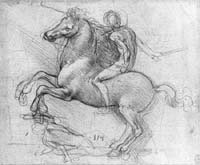
While the original project was never finished, Leonardo da Vinci’s design and innovative techniques demonstrate his heightened focus on anatomical realism and efficiency. In order to plan out his statue, Leonardo studied and sketched horses in Sforza’s stables (National Geographic). His early sketches showed that da Vinci was not only trying to get the statue to visibly look like a horse, but wanted to focus on having realistic proportions and anatomy. The following sketch shows da Vinci not focused on the pose he wanted the horse to be in, but rather understanding the anatomy of a horse.
This quality of portraying creatures as accurate models of themselves rather than just something that resembles their shape is seen in many of Leonardo’s earlier works, most famously in his Vitruvian Man. Leonardo had a great interest in thorough research, as seen in a passage in his notebook stating, “Science is an investigation by the mind which begins with the ultimate origin of a subject beyond which nothing in nature can be found to form part of the subject” (da Vinci 9). These realistic pieces represent a heightened awareness to realism, a principle of the Renaissance. Leonardo’s planned techniques to create the horse also showed Renaissance principles. In Kuhn’s essay The Structure of Scientific Revolutions, he mentions how “during revolutions scientists see new and different things when looking with familiar instruments in places they have looked before” (Kuhn 111). Da Vinci exemplified this sentiment; while using casting and molding, which had already been established, he imagined a new technique that would only require a single operation. Plaster molds would be created to shape the horse, and then the inverted molds would be buried between two ovens. Melted bronze would fill these molds to form the statue once cooled (National Geographic). Leonardo first thought that it would be best to place the mold into the ground upside-down with the hooves facing upwards, since it would be easier to fill the entire mold using the system of pipes for filling and chimneys for gas release.
After more planning, though, Leonardo decided that this approach would not work; since Milan had a water table depth of about five meters, his proposed 16 foot tall statue would not fit under the ground without breaching the water table. Leonardo decided that the only method to cast the horse would be to cast it horizontally, putting the cast into the ground with one flank facing the surface (Europeana).
By combining all work into the process of filling the molds, Leonardo designed a very effective and time-efficient way to create such a large statue; after the casts had been created, they could also be used multiple times provided they were filled with more bronze. Like many of his other invention ideas such as his war designs, Leonardo was rethinking the ‘intimacy’ of past eras and looked to experiment with techniques that would make a standard, potentially mass-produced object.
But the story of Leonardo’s horse statue doesn’t end with war and abandonment; the project was picked up again, centuries later, to form the modern statues that are based on da Vinci’s original designs. In 1977, retired pilot and Renaissance art enthusiast Charles Dent read a National Geographic article about da Vinci’s abandoned horse project and the notebooks that still existed (Atlas Obscura). Inspired, Dent resolved himself to continue da Vinci’s vision. He first created an organization called Leonardo da Vinci’s Horse, Inc. in 1982 to start building the statue. After Dent passed away in 1997, sculptor Nina Akamu stepped in to finish the statue.
This new statue was not meant to be an exact replica of what da Vinci planned for; instead, as Nina Akamu stated, it was “significantly influenced by certain works of art and writings from that period, and specifically Leonardo’s notebooks and accompanying drawings with great emphasis on his involvement with the Sforza monument” (Atlas Obscura). The final creation, measuring an impressive 25 feet tall and weighing 15 tons, was placed in San Siro Hippodrome Culture Park in Milan, Italy on September 10, 1999 (Da Vinci Science Center).
Through examining da Vinci’s early designs, study of anatomy, and innovative casting techniques, his display of Renaissance principles can be seen throughout the entire process of planning the largest equine statue. And while Leonardo never got the opportunity to finish his project, Charles Dent, Nina Akamu, and many other passionate people created a statue based on Leonardo’s original designs. This redesign represents more than just a continuation of a failed project; it stands in Milan as a celebration of da Vinci’s legacy, a display of the bond between the nations, and most importantly a representation of the ways da Vinci continues to inspire creators in the modern world.
“Study for an Equestrian Monument (Recto) – Leonardo Da Vinci – Google Arts & Culture.” Google Arts & Culture, Google, artsandculture.google.com/asset/study-for-an-equestrian-monument-recto-leonardo-da-vinci/CQHpQyy0bvQVNA?hl=en. Ugc. “Leonardo’s Horse – Il Cavallo Dello Sforza.” Atlas Obscura, Atlas Obscura, 16 Apr. 2010, www.atlasobscura.com/places/leonardo-s-horse-il-cavallo-dello-sforza.\
For a country that is many times defined by the diversity of people in it, it’s difficult to give an exact description to ‘American’ food. The American eating experience itself is characterized by the wide variety of ethnic foods you can choose from and the ‘fusion’ foods that this diverse environment creates. When comparing La Scala and Olive Garden, though, Olive Garden indisputably claims the title of ‘More American’ of the two restaurants. How could this be, if ‘American food’ is so vaguely defined?
While the ‘American’ eating experience is not restricted to certain types of food, it can be defined by its atmosphere and environment. La Scala did use more ‘authentic’ and rare ingredients than Olive Garden and boasted an impressive collection of wines, but the actual items on the menus did not seem very different. Having been at the two restaurants, what made the true difference to me between a more ‘Americanized’ restaurant and La Scala was the ambiance of the restaurants. ‘American’ restaurants such as Olive Garden have a focus on family dining- bright lights, uncluttered space, an easily navigable floor plan, and a brightly-colored kids menu. The members of your table are not the only ones who are visible; you can look around and see nearly everyone else in the restaurant. Olive Garden, as well as many other American restaurants, is a ‘break’ from the dinner table at home, and offers families a change of pace from their daily routine.
La Scala didn’t follow these conventions. The first thing I noticed was how dim the lighting was; fluorescent lights from the ceiling were replaced with muted, yellow-tinged lamps. The dark, wooden decorations impeded on the restaurant space, making the already-narrow seating space seem even more closed-in and slim. The walls leading to the private room were made of brick, and the bar inside was so large and elaborate it felt like it took up half the room. Eating at La Scala felt more intimate and closed-off; I felt very enclosed with the group I had come with, and the other tables (which were already hard to see with the low lighting) easily faded into the background. La Scala’s ambiance leaned more to having closer, intimate conversations, and the rustic brick and wooden decorations seemed to have a more ‘homey’ feel than a restaurant.
So how does this tie into authenticity? Should Olive Garden just dim the lights and add more brick furniture to truly claim that they serve ‘authentic’ Italian food? This, obviously, isn’t the case- while the difference between eating environments differ between Olive Garden and La Scala, they are just reflections of the culture that formed them, not fool-proof indicators of ‘authenticity’. Perhaps every aspect of La Scala’s perceived ‘authenticity’ were just reflections of what Americans associate with an ‘Italian experience’ rather than how restaurant culture actually is in Italy. And while I can’t speak for the eating experience in Italy, I can better define how authenticity is defined by considering the American-Chinese food scene.
Growing up eating home-cooked Chinese food as well as having visited China multiple times, I feel like I have a better measure of what constitutes as ‘authentic’ Chinese food in America. The authenticity depends on many different characteristics, and even if a restaurant seems to be ‘authentic’ it doesn’t mean that it is necessarily good. I’ve found for the food, the ingredients and cooking style is the most important- America has many ‘takes’ on authentic Chinese food so the menu items are often similar, but the biggest difference comes from how the food is actually made. Using sesame oil instead of olive oil, boiling bones in soups, and using woks (which distribute heat differently than a normal pan) seem like small changes but can really lend to the authenticity of the food. ‘Group-style’ eating with exclusively shared dishes throughout the meal is another important part of Chinese restaurants.
Going to La Scala reminded me of the vagueness of the claim to ‘authentic’ food, and encouraged me to conduct my own research about different country’s eating culture. Only then could I decide whether or not I was getting a genuine cultural experience at that restaurant. Looking not only at the items of the menu but rather the restaurant itself, from its decorations to architecture to ambiance, allowed me to better understand the cultures around me in our increasingly diverse community.
My name is Lauren Lum and I’m a Junior majoring in Computer Science with a minor in creative writing. I’ve always loved traveling, and have enjoyed visiting other countries with friends and family. My favorite trips, however, have been to places where I knew locals; during these trips, I could get a better look at the culture of the area and visit places that weren’t the usual tourist attractions. This is why I’m especially excited for this trip- while I’m, of course, looking forwards to seeing the architecture and sights of Italy, I’m more enthusiastic about learning more about Italy’s culture and the people who live there. My perception of Italy now is very surface-level; it’s limited to things I’ve seen in movies or heard about in history classes or the news. I’m familiar with some of the famous buildings or structures of Italy such as the Colosseum or the Leaning Tower of Pisa, but beyond that I don’t know much about the culture. All I can picture when I think of Italy is old architecture and tourist attractions; I am interested to see how modernized the cities are from my perception. I also know very little of the culture in Italy, so my view of Italian people is generalized to encompass all European people; if I were to assume, I’d say they likely have a better work-life balance than in the United States. I also do not know much about the diversity in Italy, but I believe that the country is less diverse than the United States. Thinking about my expectations reminded me of what Ode Botton “The Art of Travel”, where the speaker goes on a trip with his wife that does not end up to be as perfect and idealistic as he had anticipated. When considering a brochure he had seen and obsessed over before starting his trip to the location in the brochure, he says, “The longing provoked by the brochure was an example, at once touching and bathetic, of how projects (and even whole lives) might be influenced by the simplest and most unexamined images of happiness; of how a lengthy and ruinously expensive journey might be set into motion by nothing more than the sight of a photograph of a palm tree gently inclining in a tropical breeze” (Ode Botton 8). In Ode Botton’s travel experience, he let his preconceived notions of the Barbados (formed by a particularly enchanting brochure) set his expectations impossibly high for the actual location. As he traveled, every slight inconvenience ruined his perfect view of the island. Considering this, I believe that it might be better that I have little knowledge of the country of Italy and its culture beyond famous landmarks and broad geographical information; this will give me the capacity to adapt to problems I might run into abroad while not ruining any expectations I held before the trip. I don’t think any place is the can be the flawless location that Ode Botton expected before he left; in this sense, expecting too much before traveling is only setting yourself up for disappointment. I don’t have extensive knowledge about Italy’s culture, but I’m satisfied by that- and I’m excited to learn more about it when I visit.





 Italy Imagined
